Improve toss placement
Move the toss slightly forward and toward the hitting-arm side. The current toss encourages Eric to lean left and strike from underneath the ball.
Player Training Plan
Eric's detailed match data has not been added yet. The table below keeps the same space ready for actuals, baselines and status notes.
| Stat | Actual | Baseline | Status |
|---|---|---|---|
| Serve | |||
| % 1st Serve | TBA | 55.0% | Pending |
| % 1st Serve Points Won | TBA | 60.0% | Pending |
| % 2nd Serve | TBA | 78.0% | Pending |
| % Double Faults | TBA | <12.0% | Pending |
| Return | |||
| % 1st Serve Return Points Won | TBA | 32.0% | Pending |
| % 2nd Serve Return Points Won | TBA | 50.0% | Pending |
| % Return Games Won | TBA | 24.0% | Pending |
| Groundstrokes | |||
| Winners % | TBA | 8.0% | Pending |
| UE % | TBA | <28.0% | Pending |
Eric's analysis will sit here once enough match data has been entered. For now, the training plan is guided by the profile notes: a fast first serve, good touch and slice, and the need for cleaner footwork, repeatable patterns and return consistency.
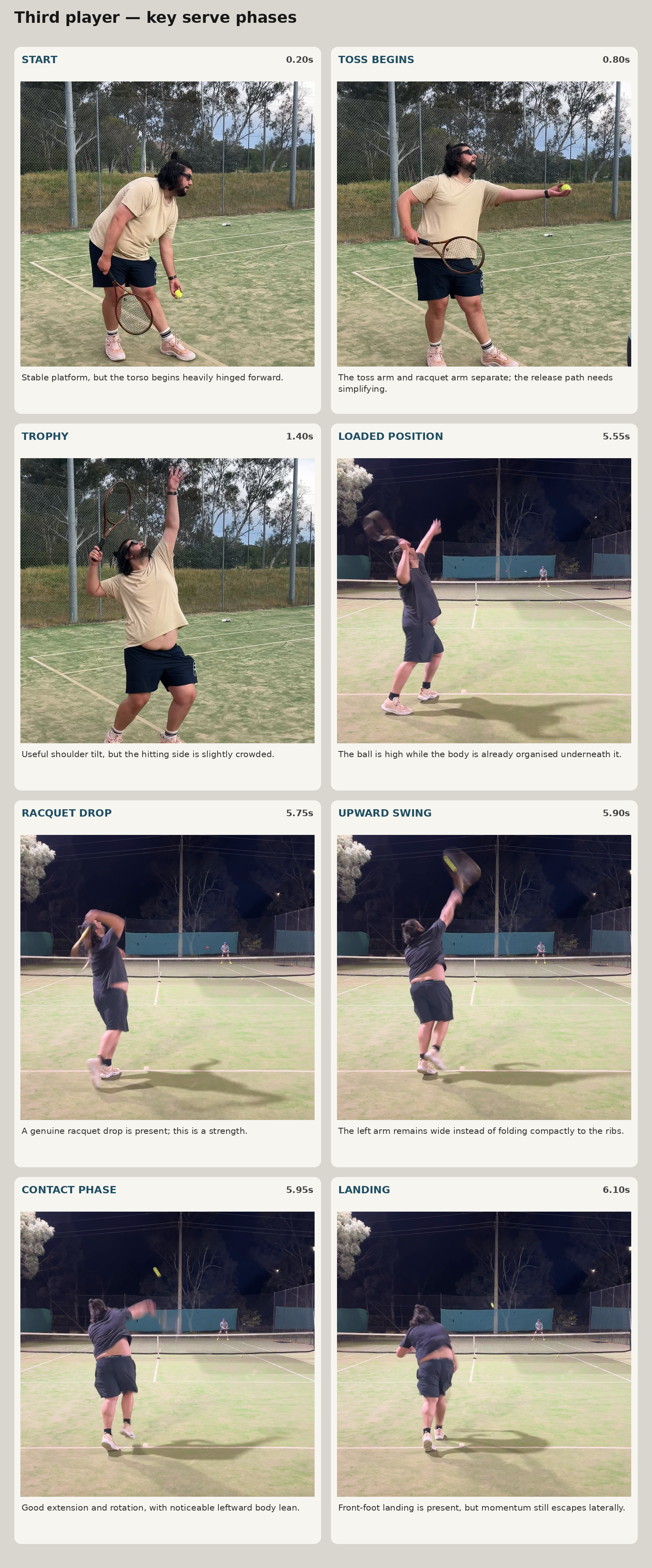
Move the toss slightly forward and toward the hitting-arm side. The current toss encourages Eric to lean left and strike from underneath the ball.
This is the clearest technical fault. The tossing arm falls outward rather than folding compactly toward the ribs, contributing to early opening, lateral movement and an unstable axis.
Reduce the leftward collapse at contact. Land with the front foot inside the court and the rear leg counterbalancing behind.
The very low, forward-hinged starting position creates unnecessary movement. A more neutral start should improve rhythm and balance.
Separate the hitting elbow from the torso, keep the racquet hand farther from the head, and preserve the existing racquet drop rather than trying to deepen it.
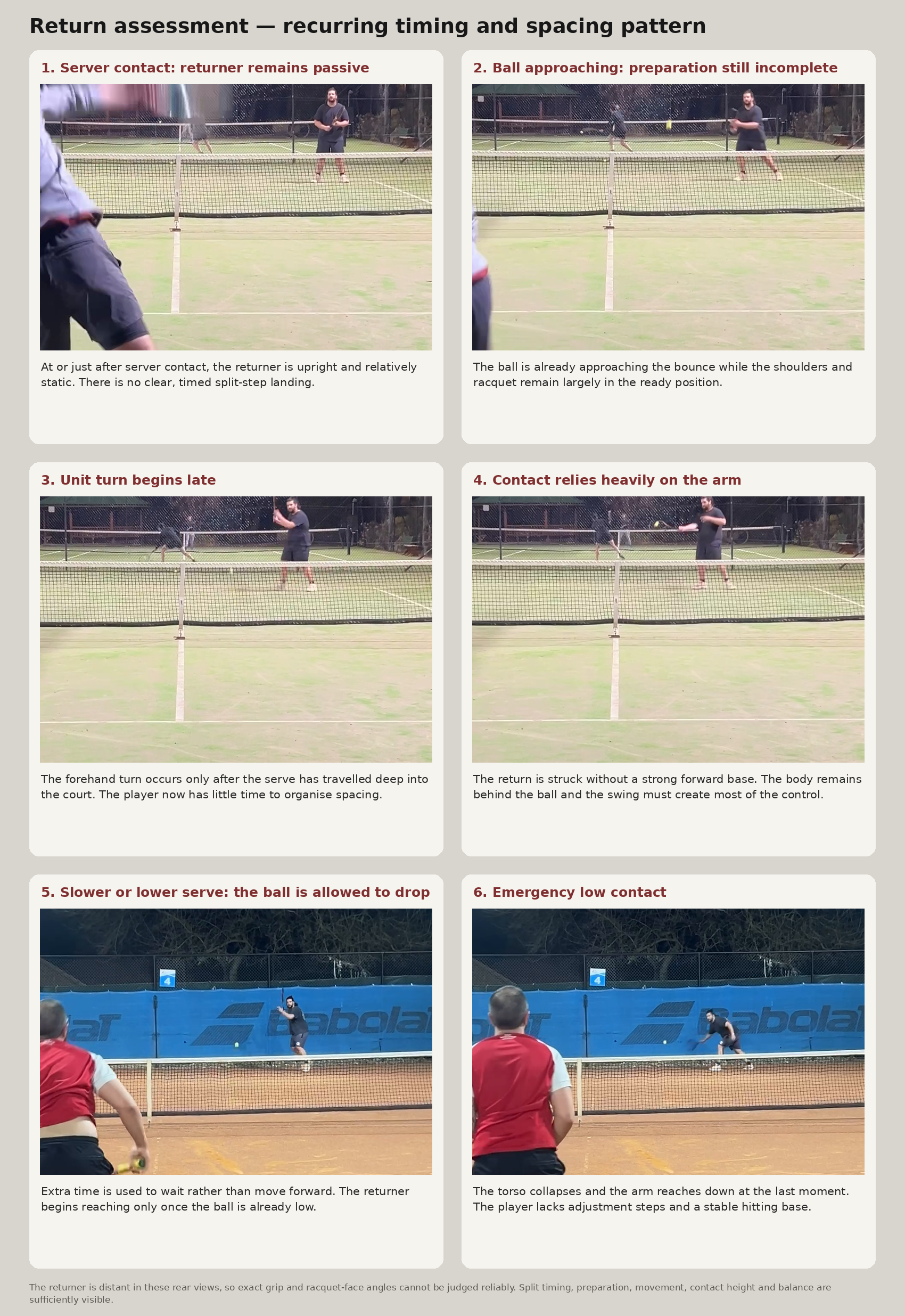
Train the split at server contact before making significant forehand changes.
The unit turn should be complete, or nearly complete, before the bounce.
Do not allow a comfortable ball to become a low emergency contact.
Move the torso and feet into the hitting zone rather than reaching with the racquet.
Fast serve means compact redirection. Slow serve means forward movement and an abbreviated groundstroke.
Keep Eric's serve training split into first-serve and second-serve work so pace, placement and reliability can be developed separately.
Complete three sets of eight tall-start shadow serves. Begin with soft knees, chest slightly higher, hands around upper-thigh height, and weight balanced between both feet.
Then serve 10 balls at 50-60% using a three-beat rhythm: rise as the arms begin, load as trophy forms, and throw with immediate upward acceleration. Pass when at least seven of 10 look continuous and balanced from the start.
Place a towel or racquet 30-50 cm inside the baseline and slightly right of the front foot. Complete three sets of eight tosses without swinging, letting the ball bounce near the target.
Add 10 toss-and-contact freezes, checking head up, hitting shoulder beneath the contact lane, no big left collapse, and weight starting to enter the court.
Finish with 12 serves at 60%, swinging only at acceptable tosses. Catch anything too far left, behind, low or far forward. Pass when at least nine of 12 allow a balanced upward swing.
Complete three sets of eight zipper shadows without a ball: reach up with the left arm, bend the elbow, pull it toward the left ribs, and keep the hand in front of the chest like closing a zipper down the front-left side.
Then do 10 shirt-grab shadows, briefly catching the left side of the shirt near the ribs as the racquet enters the drop. Do not hold the shirt through the follow-through.
Finish with three sets of six abbreviated trophy-start serves at 50-60%. Pass when the left hand no longer stays extended sideways during the upward swing on at least five of six serves.
Complete three sets of six trophy holds for two seconds. Check elbow away from ribs, hand away from ear, loose grip, left shoulder high, and chest not fully open.
From trophy, complete eight relaxed trophy-to-drop shadows. Do not force the racquet down; feel the hitting shoulder rise as the racquet head falls.
Hit eight gentle trophy-start serves. The goal is preserving space while swinging, not pace. Pass when video shows visible space between the hitting elbow and torso on six of eight attempts.
Complete 10 shadow serves and freeze at imaginary contact for two seconds. Hold the head up, hitting arm extended, chest lifted, weight toward the front leg, and no severe fall left.
Serve 12 balls from the service line at about 40% with little or no intentional jump. Focus on reaching upward, folding the left arm, staying centred, and producing easy racquet speed.
Move halfway back toward the baseline for 10 more serves. Only go to the baseline once seven of 10 can be served with a stable finish.
Without ball or racquet, complete three sets of six jump-and-stick reps from mock trophy: push upward and slightly forward, land on the left foot, extend the right leg behind, and hold for two seconds.
Create a landing box 30-60 cm inside the baseline with two cones. Hit 12 serves at 60-70%, landing the left foot in or near the box while the right leg stays behind rather than swinging hard around the side.
Finish with 10 serve, recover and split reps. After each serve, land on the front foot, recover behind the baseline, split step, and shadow a first groundstroke. Pass when eight of 10 have a controlled landing without a sideways recovery step.
This block gives Eric a cleaner return foundation: split at contact, turn early, move forward against slower serves, and choose the right return shape for the ball speed.
Run 20 server-shadow split reps with no ball. Eric begins ready, unweights as the server moves upward, lands just after imaginary contact, then pushes toward forehand or backhand when the server calls the direction.
Add clap-at-contact: the feeder serves gently and claps or says hit at contact. For the first 10 reps Eric does not hit, focusing only on landing the split around the sound. Then complete 15 live returns.
Use split-turn-freeze on easy serves to either side. Eric splits, turns the shoulders, moves the racquet into a compact set position, and freezes before swinging. Complete 10 forehands, 10 backhands and 10 random directions.
For forehands, add three sets of eight non-dominant-hand turns. Keep the left hand on the racquet throat during the initial turn so the shoulders rotate together and the hitting arm does not pull the racquet too far back.
Start with split-turn-catch from service-line feeds to the forehand. With no racquet, Eric splits, turns, moves toward the ball and catches it with both hands in front of the right hip. Complete three sets of eight.
Then complete 10 catch-and-hit pairs: catch one ball in the ideal contact zone, then hit the next from the same position. Finish with 15 moderate forehand returns and freeze for one second after contact, passing when at least 10 of 15 holds are stable.
Place two cones 30-60 cm inside the baseline as a forward landing line. Against slow second serves, Eric starts on or just behind the baseline, splits forward, moves diagonally into the ball, contacts before it drops below upper-thigh height, and lands or steps near the cone line. Complete three sets of eight.
Add 15 catch-above-the-knee reps before using the racquet, then hit 20 take-it-on-the-rise returns with compact preparation, forward body movement, controlled topspin and a deep-middle target.
Use preset block returns against medium-fast service-line feeds. Eric begins with shoulders slightly turned, racquet beside the torso, hands in front and a short follow-through. Complete three sets of eight.
Then place a safe visual barrier behind the forehand preparation area for 15 no-loop returns into the deep middle. Pass by making at least 11 of 15 while keeping the stroke compact.
The server randomly delivers a faster serve or slower serve. Eric calls block or drive before the bounce. Block means minimal backswing, stable face, using incoming pace and deep-middle target.
Drive means moving forward, using a slightly fuller but still compact swing, contacting earlier, and aiming to a large crosscourt or middle target. Complete 24 serves and pass when the correct shape is selected on at least 18.
Place a cone near the expected recovery position. After every return, Eric must move around the cone and split again. Complete 16 returns, counting only reps where the return lands in, balance holds and recovery begins immediately.
Then play 15 return-plus-first-ball points. Score one point each for return in, balanced recovery and first groundstroke in. This keeps the return connected to the rest of the point.
Coach or partner feeds alternating depths. Eric must split, adjust and call the target before contact.
Start with a backhand slice crosscourt, recover, then look for the first balanced forehand to take control.