Josh is close on raw points, but the 3.5 target asks him to clear 52% rather than merely break even.
01Stats & Analysis
Baselines are set as aspirational UTR 3.5 targets. The data does not split first and second serves or returns, so available rates use total points as the denominator where needed.
Josh Neri
4 of 10 UTR 3.5 checks metHold rate, ace output and double-fault rate are all outside the aspirational 3.5 target band.
Break conversion still holds up well, while break-point defence sits short of the higher target.
Error tolerance and opponent-error production are good; winner output is the main rally gap.
| Stat | Actual | Baseline | Status |
|---|---|---|---|
| Match Overview | |||
| Points Won % | 50.8% | 52.0% | 1.2 below |
| Serve | |||
| % Service Games Won | 35.7% | 50.0% | 14.3 below |
| % Aces | 0.0% | 1.5% | 1.5 below |
| % Double Faults | 14.9% | <12.0% | 2.9 over |
| Pressure | |||
| % Break Points Converted | 50.0% | 42.0% | 8.0 above |
| % Break Points Saved | 35.7% | 45.0% | 9.3 below |
| Point Outcomes | |||
| Winners % | 4.6% | 8.0% | 3.4 below |
| Unforced Error % | 24.1% | <28.0% | 3.9 under |
| Forced Error % | 10.3% | <11.0% | 0.7 under |
| Opponent Error % | 46.2% | 38.0% | 8.2 above |
Analysis
The numbers are closer than the service games make them feel
Josh is winning 50.8% of total points, so across this sample he is basically playing opponents even. That is the most important starting point: the matches are not running away from him point by point. They are being decided by where those points cluster.
The serve numbers are the obvious drag. A 35.7% service-game win rate is low for someone who is otherwise winning slightly more points than he loses, and the 14.9% double-fault rate explains a lot of that mismatch. There are enough free lost points on serve to turn otherwise even sets into constant pressure games.
The return-side picture looks much healthier. Josh is converting 50.0% of break points, which is already above the 3.5 target, so he is getting into opponents' service games and taking a fair share of the chances he creates. The contrast is sharp: he is dangerous enough when receiving, but not yet protected enough when serving.
The rally numbers are quietly positive. Unforced errors at 24.1% and forced errors at 10.3% are both inside the tougher target range, and opponents are making errors on 46.2% of points. That suggests Josh is doing a good job staying in points and making the other player play, even if the winner count is not high yet.
The one thing missing from the point-outcome profile is cheap offence. Winners are only 4.6% of points, well short of the 8.0% aspirational target. So the statistical picture is a player who competes well, draws plenty of mistakes, and creates return pressure, but still needs more security on serve and a little more clean finishing power to look like a 3.5-level player.
02Priorities
Serve
View serve visual guide
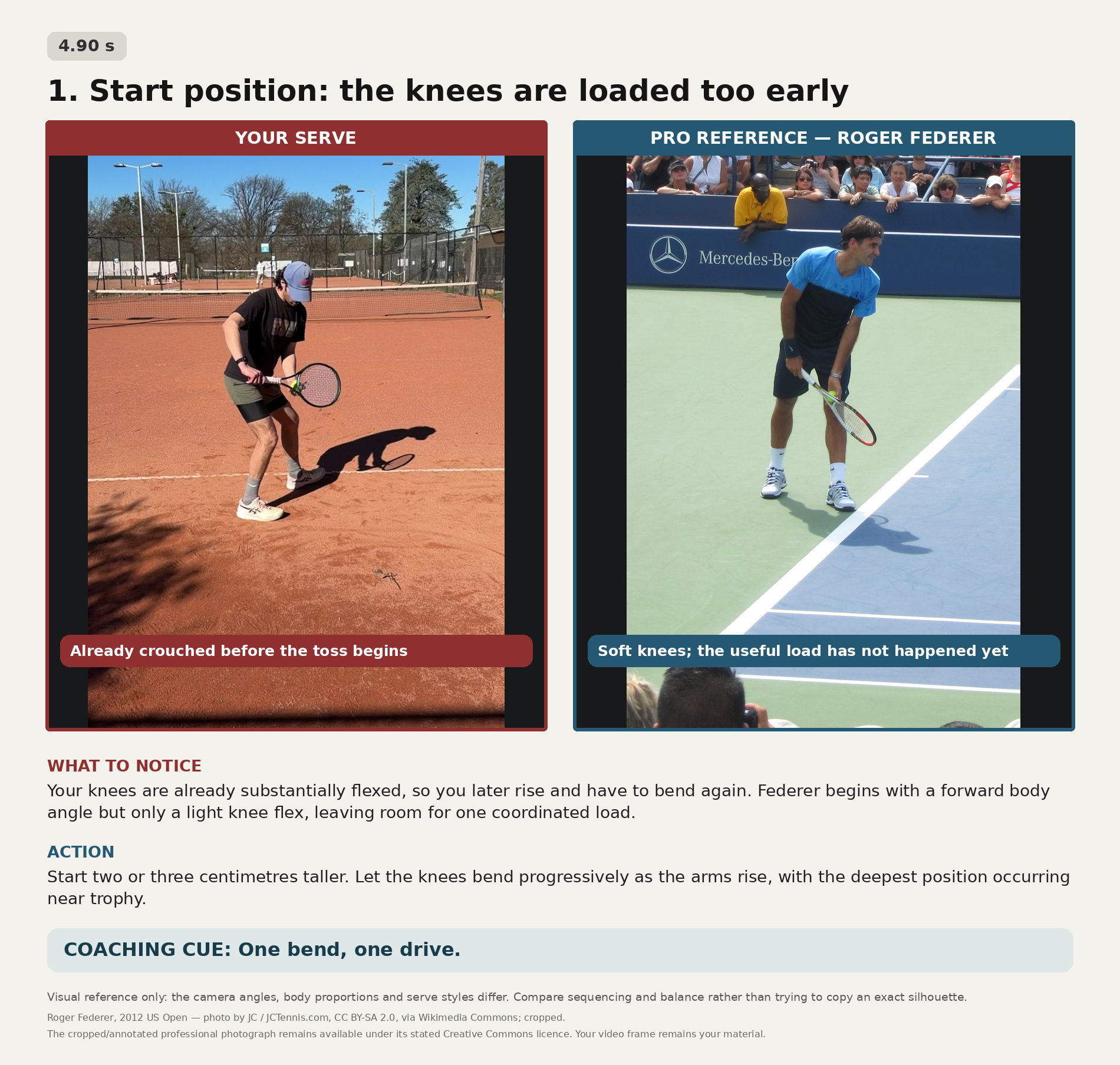
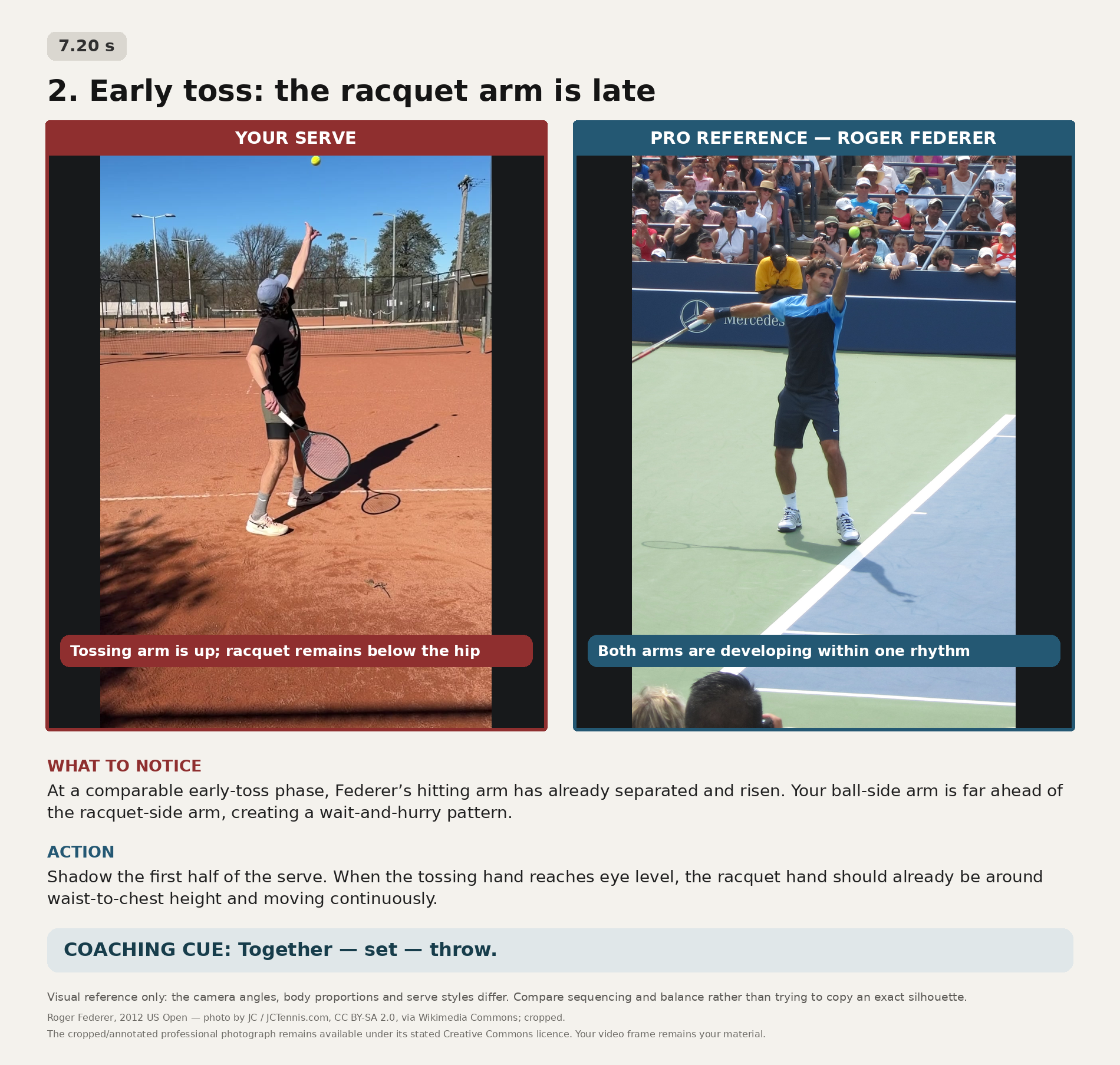
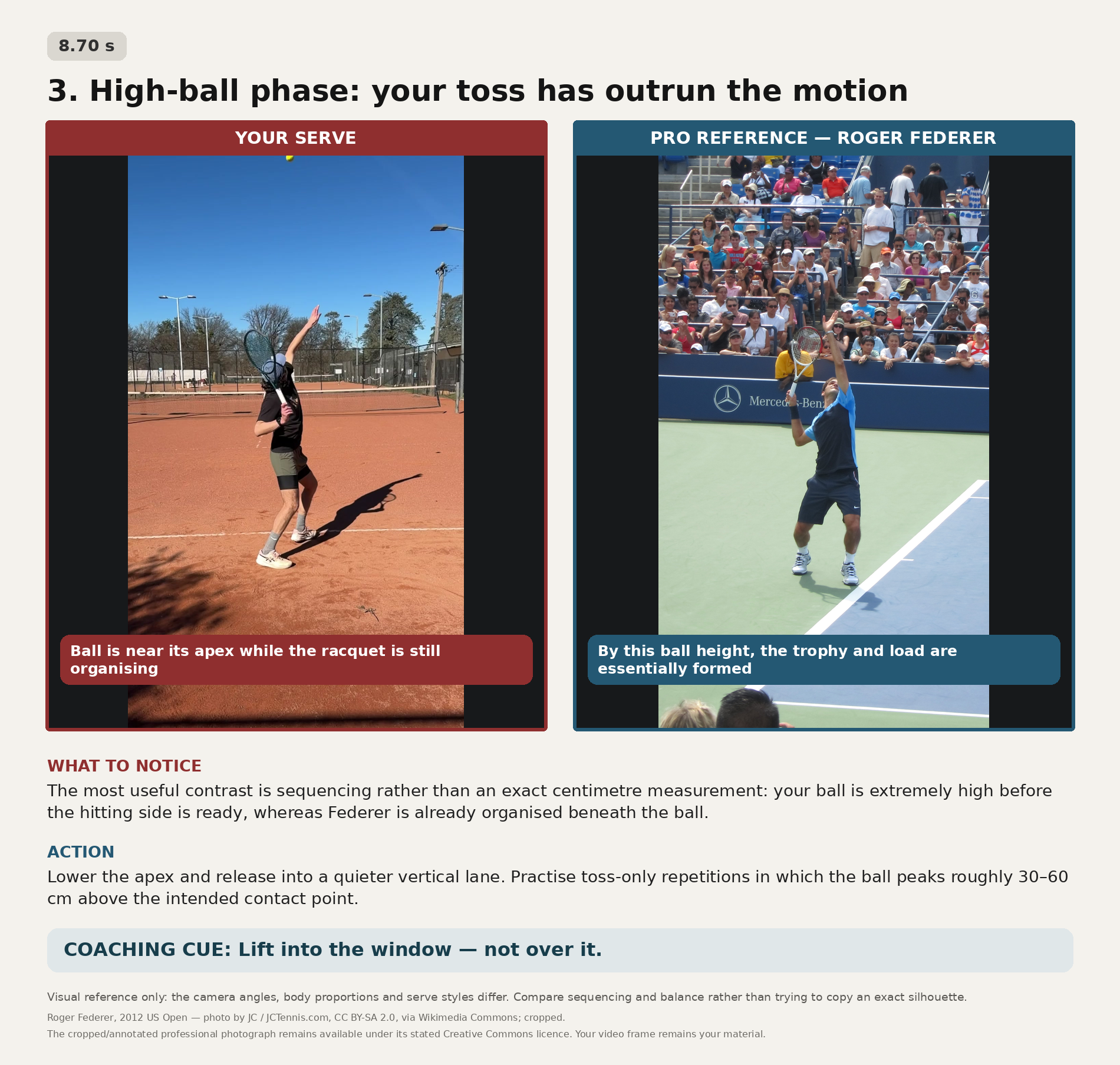
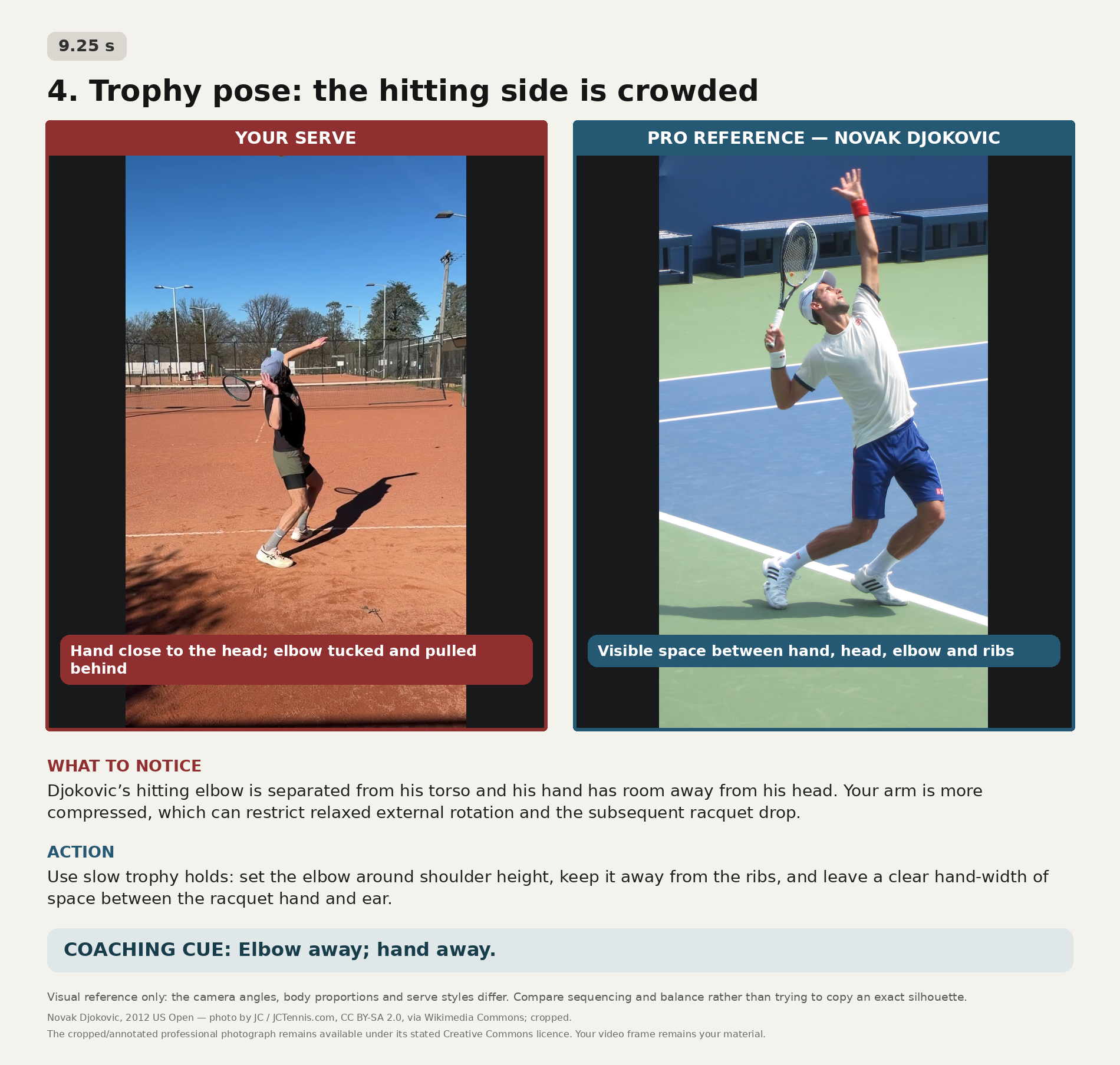
Rebuild the toss
Lower the first-serve toss and make it travel through a quieter, less diagonal lane. For the second serve, place it closer to 12 o'clock without throwing it excessively behind the head.
Synchronise the arms
The racquet arm currently lags well behind the tossing arm. The racquet hand should already be rising when the tossing hand reaches eye level.
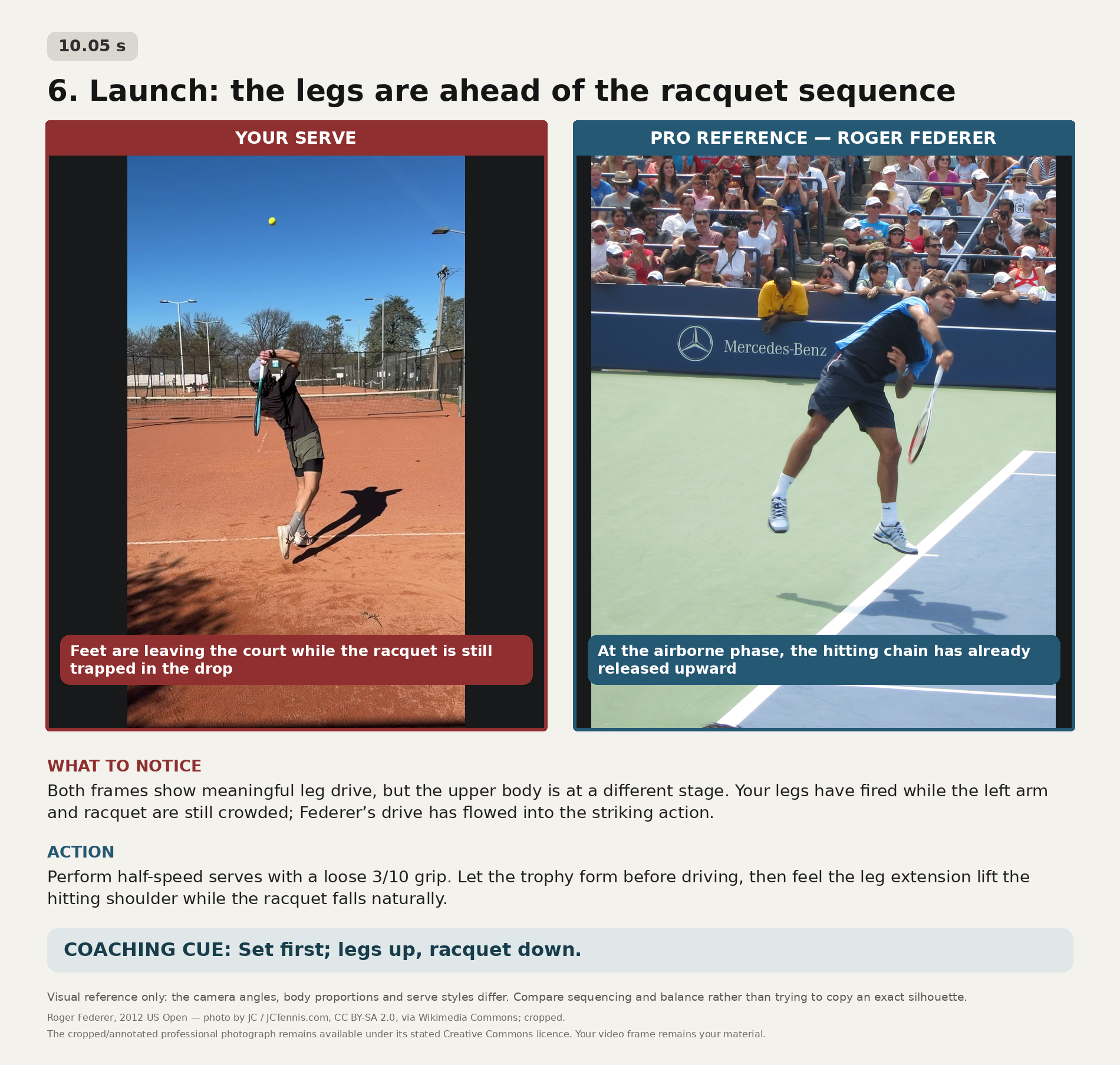
Simplify the leg load
Replace the early crouch and dip-rise-dip pattern with one progressive knee bend. Reach the deepest load around trophy, then drive immediately.
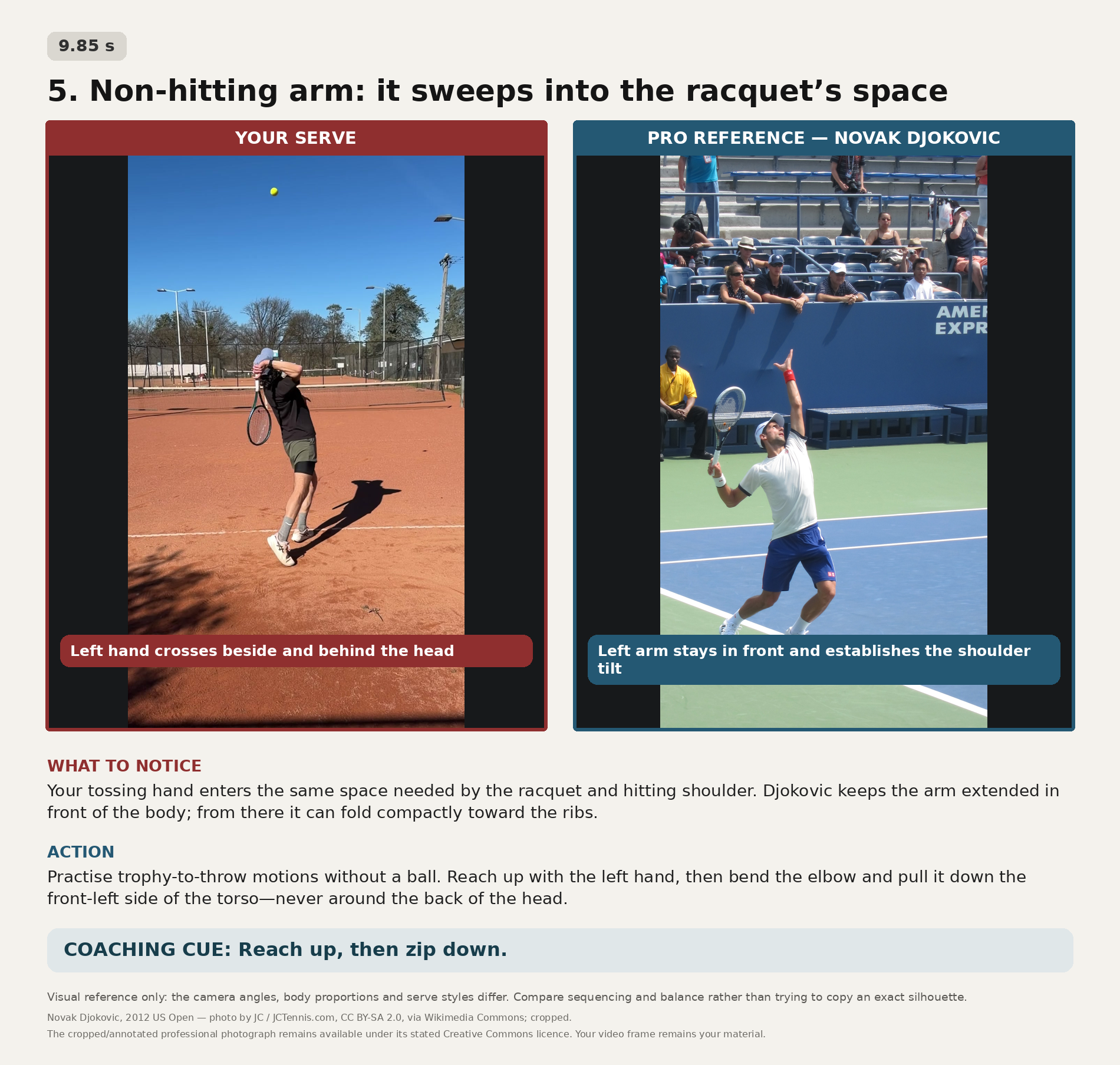
Compact the tossing arm
Reach upward, then pull the non-hitting elbow toward the ribs. Stop the hand from travelling behind or across the head.
Build a spin second serve
The second-serve percentage is the most urgent competitive problem. Start with topspin-slice rather than chasing an extreme kick serve, and practise high net clearance, committed upward racquet speed and large targets.
Return
View return visual guide
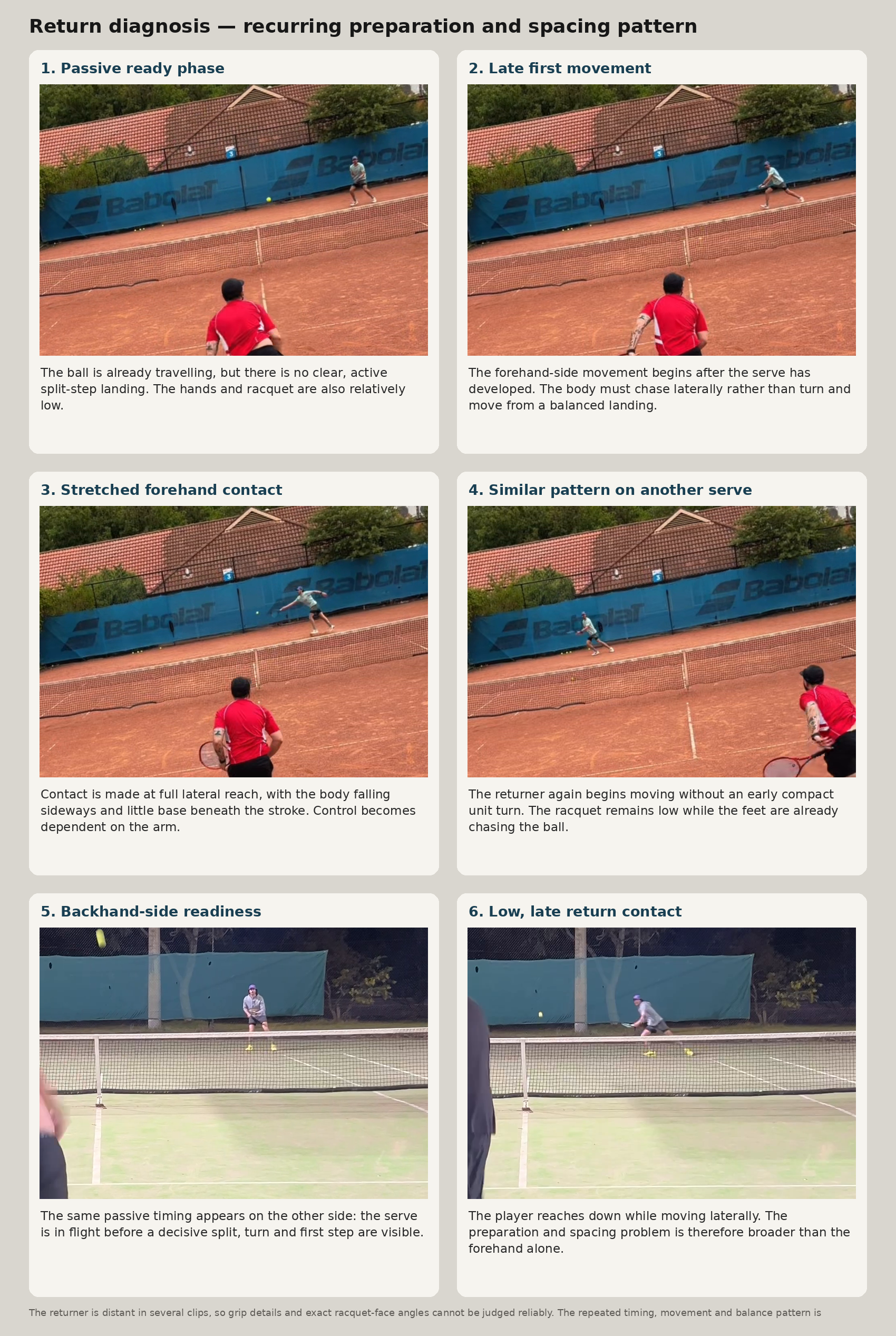
Time the split step
This is the upstream correction. Without it, Josh will keep reacting late regardless of which forehand technique he practises.
Turn during the first move
The shoulders and racquet must prepare while Josh travels, rather than waiting until after he arrives at the ball.
Improve forehand spacing
Move the body into the hitting zone instead of extending the arm to wherever the ball happens to be.
Attack slow serves forward
Slower serves should be attacked diagonally forward. Do not let the ball drag Josh sideways or drop below the preferred contact height.
Separate return shapes
Fast serve means compact block. Slow serve means step-in abbreviated drive.
Forehand
View forehand visual guide
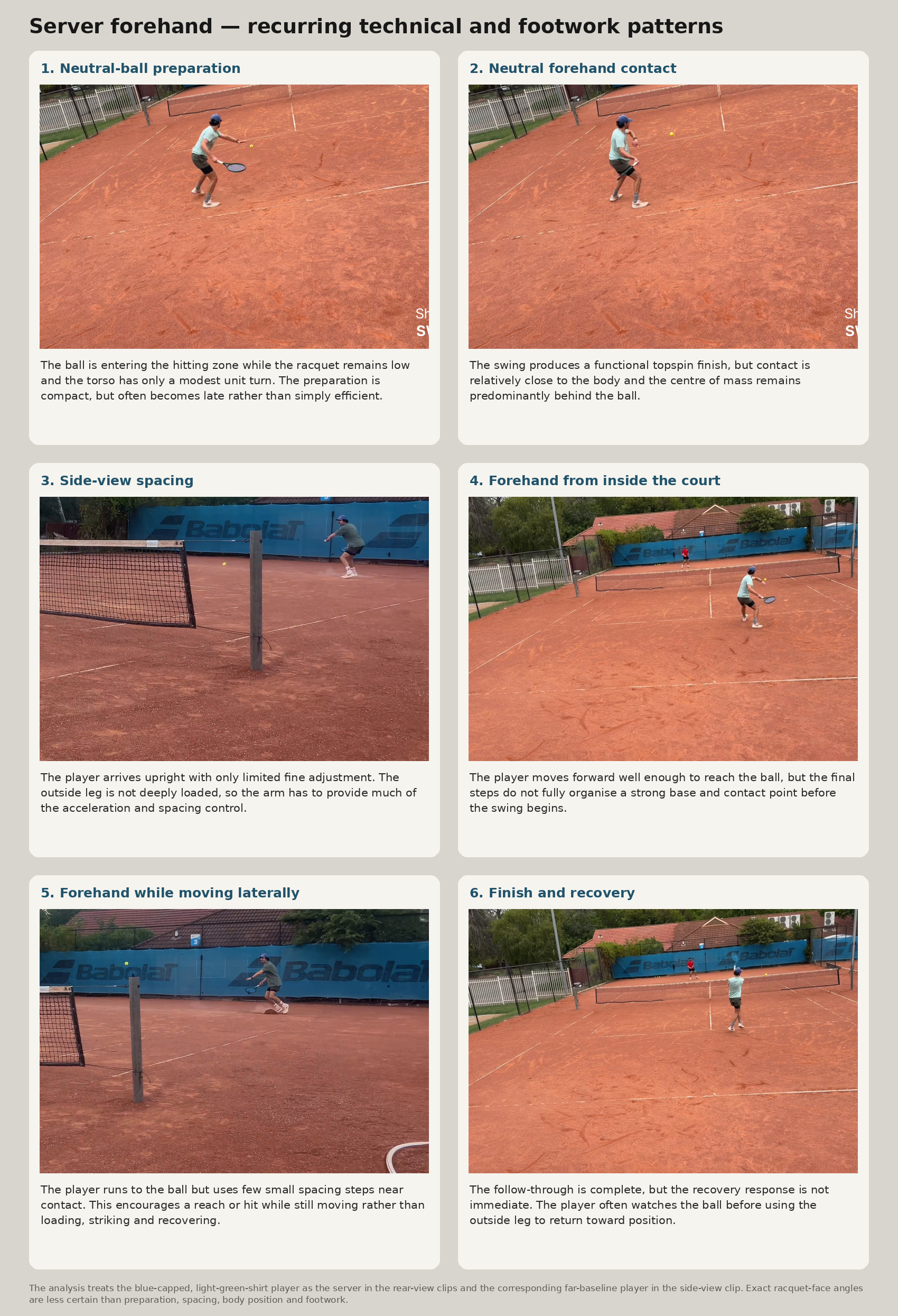
Earlier unit turn
Keep the compact swing, but begin it earlier so the racquet and shoulders are organised before the ball arrives.
Final adjustment steps
Improve the transition from covering distance to establishing precise spacing, especially when moving forward or wide.
Outside-leg load
Create a more stable base and involve the lower body before the racquet accelerates.
Contact farther in front and away
Achieve this through positioning rather than forced arm extension or reaching late for the ball.
Immediate recovery
The forehand finish and first recovery step should become one connected action.
03Training Blocks
Serve
Serve rebuild: toss, rhythm and landing
This block is Josh's first serve priority. Keep the pace controlled, use video where noted, and judge success by repeatability before speed.
First Serve
Lift into the window
Stand at the baseline and extend the racquet to the contact point. The toss should peak about 30-60 cm above that point, not several feet above it.
Do three sets of eight tosses without swinging. Let each ball fall near a cone 30-50 cm inside the baseline, slightly right of the front foot and in the intended contact lane.
Then complete 10 toss-and-freeze reps: start the motion, release the ball, freeze at trophy, watch the peak and landing, then catch after the bounce.
Finish with 10 serves at 60-70%, swinging only at acceptable tosses. Move on when at least 7 of 10 tosses peak in the window, stay on the hitting-arm side and do not force a long wait.
Together, set, throw
Complete three sets of eight slow shadow serves. Pause when the tossing hand reaches eye level; the racquet hand should already be around waist-to-chest height and travelling upward.
Hit five abbreviated-start serves at 50-60% with the racquet hand beginning around waist height, then five serves from the normal start. Alternate one abbreviated serve and one normal serve for five pairs.
On video, pause when the tossing hand is around eye level. Pass when the racquet hand is clearly rising and no longer below the hip on four of five serves.
Start tall; one bend, one drive
The goal is not less knee bend. The goal is replacing the dip-rise-dip pattern with one progressive load.
Without a ball, do three sets of six motions: start tall with soft knees, lift both arms, bend gradually, reach the deepest position near trophy, drive upward, then freeze for two seconds.
Do 10 tosses without swinging, keeping the knees progressively more flexed as the arms rise. Then serve eight balls at about 60% and score each rep as one load or two loads. Pass with six of eight one-load serves.
Elbow away, hand away
Set up three sets of six static trophy positions. Hold each for three seconds and check that the elbow is around shoulder height or slightly below, separated from the ribs, with the hand away from the ear and grip pressure around 3/10.
Then start in trophy and complete eight smooth throwing actions. Do not force the racquet down the back; keep the arm loose and let the drop emerge as the shoulder rises.
Finish with eight trophy-start serves at 50-60%. Pass when at least six of eight show daylight between elbow and torso, and between hand and head.
Reach up, then zip down
The tossing arm should create shoulder tilt, then fold compactly down the front-left side of the torso rather than crossing behind the head.
Do three sets of eight zipper shadows: reach up at trophy, bend the left elbow, pull it toward the left ribs, and bring the hand down in front of the chest as if closing a zipper toward the left front pocket.
Add 10 shirt-grab shadows, briefly grabbing the left side of the shirt around the lower ribs after the fold. Then serve eight balls at 60-70%, exaggerating the compact fold for the first four and making it natural for the final four.
Set first; legs up, racquet down
Serve five balls from trophy without deliberately jumping. Let the racquet fall, the elbow extend, and the shoulder and forearm rotate so the arm sequence is organised before adding leg drive.
Then complete three sets of six settle-and-drive shadows: reach trophy, feel a brief moment of organisation, drive upward, and feel the racquet head move down as the hitting shoulder moves up.
Serve 3 balls with no intentional jump, 3 with moderate leg drive and 4 with normal leg drive, all below 75%. On video, the racquet should be moving into the drop as the heels lift.
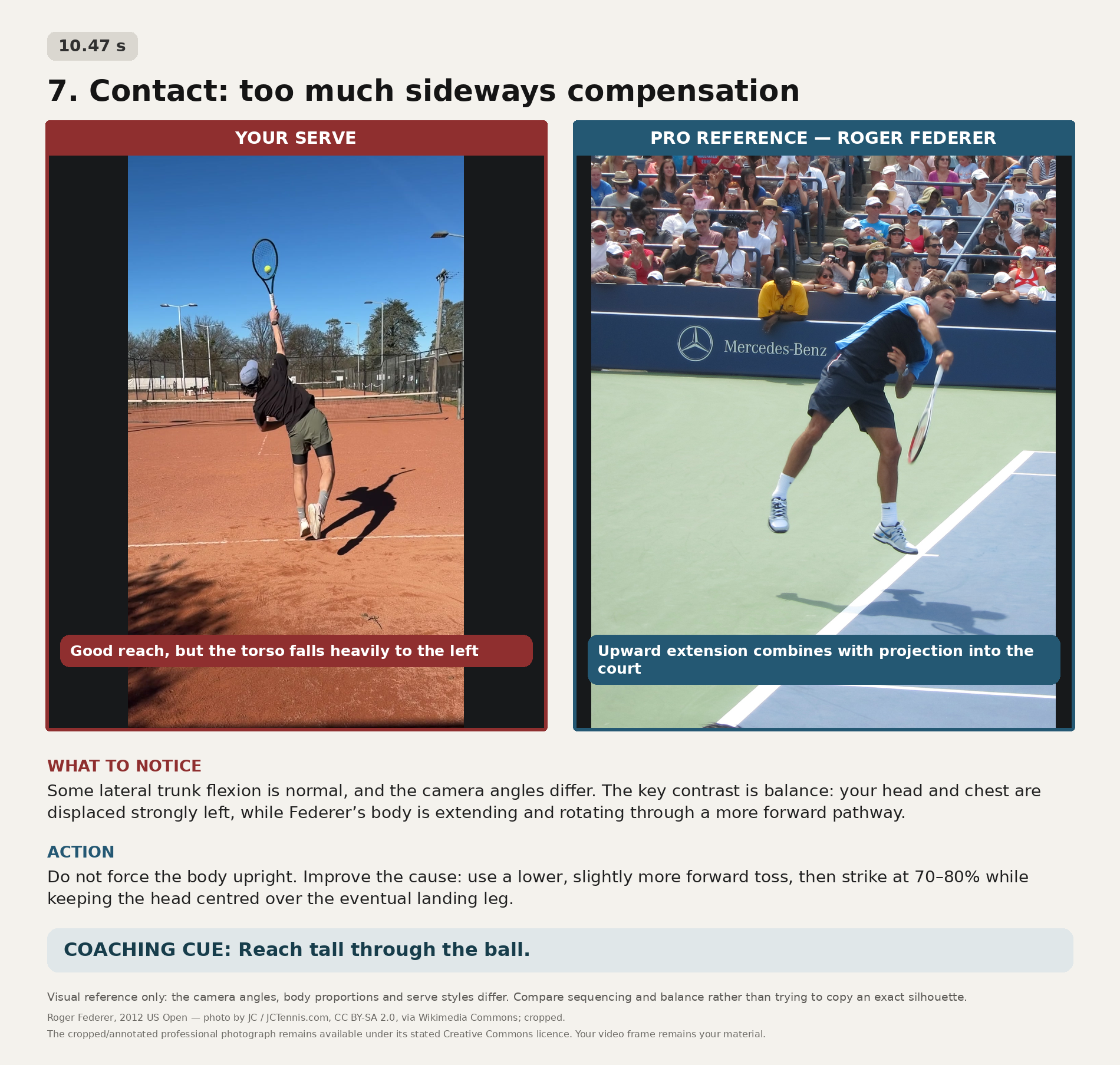
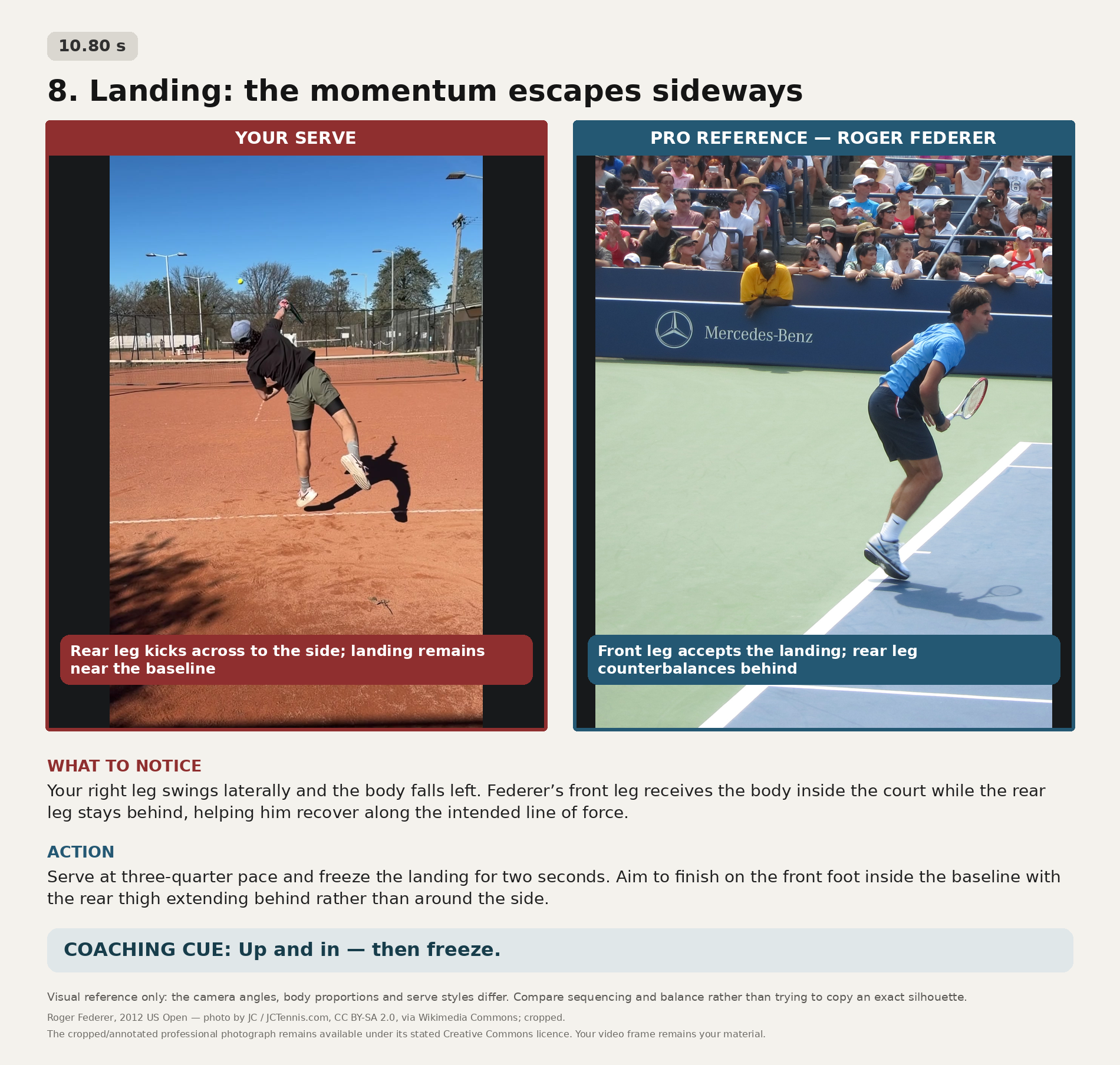
Reach tall, up and in
Complete eight contact-position freezes. Check for an extended hitting arm, head still looking upward, chest lifted, no sharp collapse left, and weight moving toward the front leg.
Move to the service line and serve 10 gentle balls with no deliberate jump, extending upward through the ball and staying balanced. Then return to the baseline for 10 serves at 65-75%, letting contact and momentum move toward a cone 30-50 cm inside the court.
For landing, do three sets of six jump-and-stick reps without racquet or ball: push upward and slightly forward from mock trophy, land on the left foot, extend the right leg behind, and hold for two seconds.
Create a landing box 30-60 cm inside the baseline and serve 10 balls at 60-70%, freezing after each serve. Then serve 10 more, recover behind the baseline, split step, and shadow a first forehand or backhand. Pass with eight of ten left-foot landings inside the court, right leg behind, and two seconds of balance.
Second Serve
Edge first, strings later
Do three sets of 10 slow shadow swings from trophy: racquet drops behind the body, edge leads upward, then the strings rotate after the imagined contact.
Add three sets of eight fence-brush shadows from about one racquet length away from a side fence. Feel the racquet travelling up along the fence line rather than pushing forward into it.
Fast arm, slow ball
From the service line, serve diagonally at 40-50% effort. The ball should clear the net by at least one metre, arc visibly, and sound soft and spinny rather than flat.
Complete three sets of 10, aiming well inside the box. Move on when at least seven of 10 land in with generous net clearance.
Drop, brush, reach
Start in trophy halfway between the service line and baseline with the tossing arm raised, hitting elbow away from the ribs, racquet relaxed, and knees only lightly bent.
Complete three sets of eight modest-toss serves, focusing on racquet drop, upward acceleration, brushing contact and a balanced finish.
Optional low-intensity variation: two sets of six half-kneeling brush serves from inside the baseline or near the service line. Stop immediately if the shoulder or back feels uncomfortable.
Place it above me
The second-serve toss should sit slightly left of the flat-serve toss, around 12 o'clock relative to the head, less forward than the first serve, but still comfortably reachable without falling sideways.
Place a racquet or towel where the toss should land. Do four sets of eight tosses without swinging and pass when six of eight land within about one racquet-head width of the target.
Then do 15 toss, trophy and catch reps. Do not chase the ball, move the front foot, bend dramatically sideways, or collapse the head and chest.
Shoulder up, chest sideways
Do 10 slow side-on freeze shadows and then eight gentle serves. Just before the upward swing, check that the front shoulder is higher, the chest is not already facing the net, the head is looking up, and the elbow is away from the torso.
Use three sets of six back-pocket awareness reps if Josh opens early. A partner can call go once he reaches a stable side-on trophy, but do not turn it into a long pause.
See the blur above you
Serve two sets of eight at 50-60% from three-quarter court. After contact, keep the eyes up for an exaggerated half-second before the head returns naturally.
Add 10 slow chest-to-sky shadow serves with the cue sternum up through contact. The goal is upward extension, not forcing the neck backward.
Same spin, longer court
Only move back when the serve shape survives. Hit five successful serves from the service line, two metres behind it, three-quarter court, then the baseline.
Each distance allows a maximum of eight attempts. If the level fails, move forward again rather than forcing baseline second serves.
Commit upward
Complete five cycles of three serves: one confident spin serve into a large target, one deliberate long miss using the same upward racquet speed, then one more confident spin serve into the target.
The long miss should still have spin. The lesson is that missing long with commitment is better than decelerating into the net.
Return
Return timing, spacing and attack
This block builds the return from the ground up: split timing first, then shoulder turn, compact forehand shape, wide-serve spacing and slower-serve aggression.
Land, then explode
Start with server-shadow split: the server performs 15 service motions while Josh begins ready, initiates the hop as the server drives upward, lands just after imaginary contact, then turns toward the called direction. Complete three sets of five.
Add audible-contact split. The server hits easy serves and calls hit at contact. Josh catches the first eight balls instead of returning, then plays 12 returns. Pass when he is landing or loaded before the ball crosses the net on eight of 10 returns.
Chest turns with the first step
Use split-turn-catch without a racquet first. A partner feeds toward forehand and backhand; Josh split steps, turns the shoulders immediately, moves toward the ball, and catches it with both hands in front of the intended contact point. Complete three sets of eight.
Then use 10 forehand and 10 backhand racquet-throat turns. Begin with the non-dominant hand on the throat, split as the feeder strikes, turn the racquet and shoulders together, set no farther back than the side of the torso, then freeze before swinging.
Set, meet, finish
For no-backswing returns, start with the racquet slightly turned beside the body. Return medium-paced forehand feeds into a large target using a short forward swing, firm wrist, contact in front, and a finish no higher than shoulder level. Complete three sets of eight.
Add a safe backswing barrier behind the forehand side for 15 returns, then complete 10 block-versus-drive pairs: call block for the faster feed and drive for the slower feed.
Get the right hip behind it
Set cones at the starting spot and about two metres toward the forehand sideline. Josh split steps, pushes from the inside leg, turns, moves laterally and slightly forward, catches in front of the right hip, and holds balance for two seconds. Complete three sets of six.
Then return three sets of eight open-stance forehands from service-line feeds, using outside-leg movement and a compact turn. Finish with 10 wide return plus recovery reps, scoring only returns that land in with balance and immediate recovery.
Go to the bounce
For slow-serve interception, the server hits 50-60% serves toward the forehand. Josh starts on or just behind the baseline, moves diagonally forward after the split, and contacts before the ball drops below waist height. Complete three sets of eight.
Add 20 short/slow recognition serves: call hold for normal pace and go for slow. On go, the first move must be diagonally forward. Finish with 15 take-it-on-the-rise returns, aiming deep through the middle at 60-70%.
Deep middle first
The default return target is the deep middle third because it gives the most margin, reduces the server's angle, gives recovery time, and discourages over-rotation or line hunting.
Mark a large target between the centre service-line extensions and beyond the service line. Score 20 returns: two points for deep middle, one for in play elsewhere, and zero for a miss. Target 28 points from 40.
Forehand
Forehand spacing, loading and recovery
This block keeps Josh's compact forehand shape, but trains the pieces around it: earlier preparation, sharper spacing, outside-leg loading, cleaner contact and immediate recovery.
Turn-before-bounce drill
A partner feeds or rallies only to the forehand. Josh must say set once the unit turn is complete, and that call must happen before the ball bounces.
Josh then catches the ball or hits at 50%. Complete three sets of eight.
Pass when at least six of eight unit turns are completed before the bounce. Cue: turn before the bounce.
Big-steps, small-steps catch drill
The feeder tosses balls to different forehand locations. Without a racquet, Josh split steps, uses large steps to cover distance, takes at least two short adjustment steps, catches the ball with both hands in front of the right hip, then holds balance.
Complete eight neutral balls, eight short balls and eight wide balls. This removes the swing and exposes the spacing problem clearly.
Cue: big, big, small, small.
Outside-leg load and stick
The feeder sends comfortable forehands. Josh uses an open or semi-open stance, loads the right leg, keeps the right knee flexed, hits at 60%, then holds the finish for two seconds.
Complete three sets of eight. Josh should feel pressure through the outside hip before the swing begins.
Pass when he can hold seven of eight finishes without falling backward, falling sideways or crossing the feet immediately. Cue: load, hit, stick.
Short-ball braking drill
The feeder alternates deep and short forehands. On a short ball, Josh uses two or three large forward steps, takes two shorter braking steps, establishes a neutral or controlled semi-open base, strikes through the ball and continues forward under balance.
Complete three sets of six short balls. A repetition does not count if Josh runs directly into the contact point and swings while still uncontrolled.
Cue: get there fast; hit there slowly.
Serve-plus-one forehand
Because these are forehands struck by the server, the serve-to-first-forehand transition should be trained directly. Josh serves at 70%, lands and recovers, split steps as the partner returns, turns immediately if the ball comes to the forehand, hits a controlled serve-plus-one forehand to a large target, then recovers.
The returner should initially feed the first ball predictably to the forehand. Complete three sets of six points.
Progress to random forehand/backhand returns, with Josh hitting only the forehand balls and catching or stopping the others. Cue: serve, recover, turn.
Three-location random drill
The feeder randomly selects a neutral/deep forehand, short forehand or wide forehand. Josh must use the correct footwork pattern for each ball.
Neutral balls need small adjustment steps and outside-leg load. Short balls need big forward movement, braking steps and then the strike. Wide balls need a crossover, outside-leg plant, open-stance strike and recovery.
Complete four sets of six. Do not score power; score correct movement pattern, spacing, balance and recovery.