Serve impact clears the 5.33 bar, but serve volume and double faults are still the drag on hold rate.
← Back to training profiles
Serve
3/7
Return
4/4
Pressure
1/3
Groundstrokes
6/7
01Stats & Analysis
Baselines are adjusted to Matt's current singles UTR of 5.33. They are designed to be aspirational training targets, not generic tour-style ideals.
Matt Evans
14 of 21 UTR 5.33 checks metThe return numbers are the clear engine: every return benchmark is above target, including return games won.
Break conversion is strong for the level, but break-point defence and tiebreaks remain the clear pressure gaps.
Error control, backhand output and forced errors are ahead; the forehand winner target is now the fine-margin gap.
| Stat | Actual | Baseline | Status |
|---|---|---|---|
| Serve | |||
| % 1st Serve | 49.0% | 58.0% | 9.0 below |
| % 1st Serve Points Won | 73.7% | 68.0% | 5.7 above |
| % 2nd Serve | 60.9% | 62.0% | 1.1 below |
| % 2nd Serve Points Won | 39.4% | 40.0% | 0.6 below |
| % Service Games Won | 65.8% | 65.0% | 0.8 above |
| % Aces | 4.1% | 3.5% | 0.6 above |
| % Double Faults | 20.0% | <13.0% | 7.0 over |
| Return | |||
| % 1st Serve Return Points Won | 51.8% | 36.0% | 15.8 above |
| % 2nd Serve Return Points Won | 68.8% | 56.0% | 12.8 above |
| % Return Games Won | 69.0% | 42.0% | 27.0 above |
| % Break Points Converted | 58.4% | 42.0% | 16.4 above |
| Pressure | |||
| % Break Points Converted | 58.4% | 42.0% | 16.4 above |
| % Break Points Saved | 44.1% | 50.0% | 5.9 below |
| % Tie Breaks Won | 16.7% | 50.0% | 33.3 below |
| Groundstrokes | |||
| Forehand Winner % | 6.2% | 6.5% | 0.3 below |
| Forehand UE % | 12.0% | <18.0% | 6.0 under |
| Backhand Winner % | 7.4% | 5.5% | 1.9 above |
| Backhand Error % | 9.6% | <14.0% | 4.4 under |
| Opponent Forced Error % | 18.6% | 18.0% | 0.6 above |
| Winners % | 13.6% | 11.0% | 2.6 above |
| UE % | 21.6% | <22.0% | 0.4 under |
Analysis
Matt's performance profile
Matt's game is built around one of the most dangerous return packages at his level. The numbers tell a clear story: winning 51.8% of first-serve return points and 68.8% off the second serve are figures that would turn heads at any club level, and converting 58.4% of break point opportunities while winning 69% of return games means opponents simply cannot relax on serve against him.
Where Matt's game has a genuine structural problem is the serve, and it cascades through everything. Landing only 49% of first serves means he is living on his second delivery far more than is comfortable, and that second serve is itself unreliable, going in only 60.9% of the time and producing a double fault rate of 20%.
The pressure statistics are where these threads converge. His return game means he creates break point opportunities at an extraordinary rate and finishes them ruthlessly, but his serve means he is regularly on the back foot defending his own games. The development roadmap writes itself: a more consistent first serve and a more trustworthy second would reduce break point exposure, improve tiebreak performance, and let the rest of his game operate from security rather than catch-up.
02Priorities
Serve
View serve visual guide
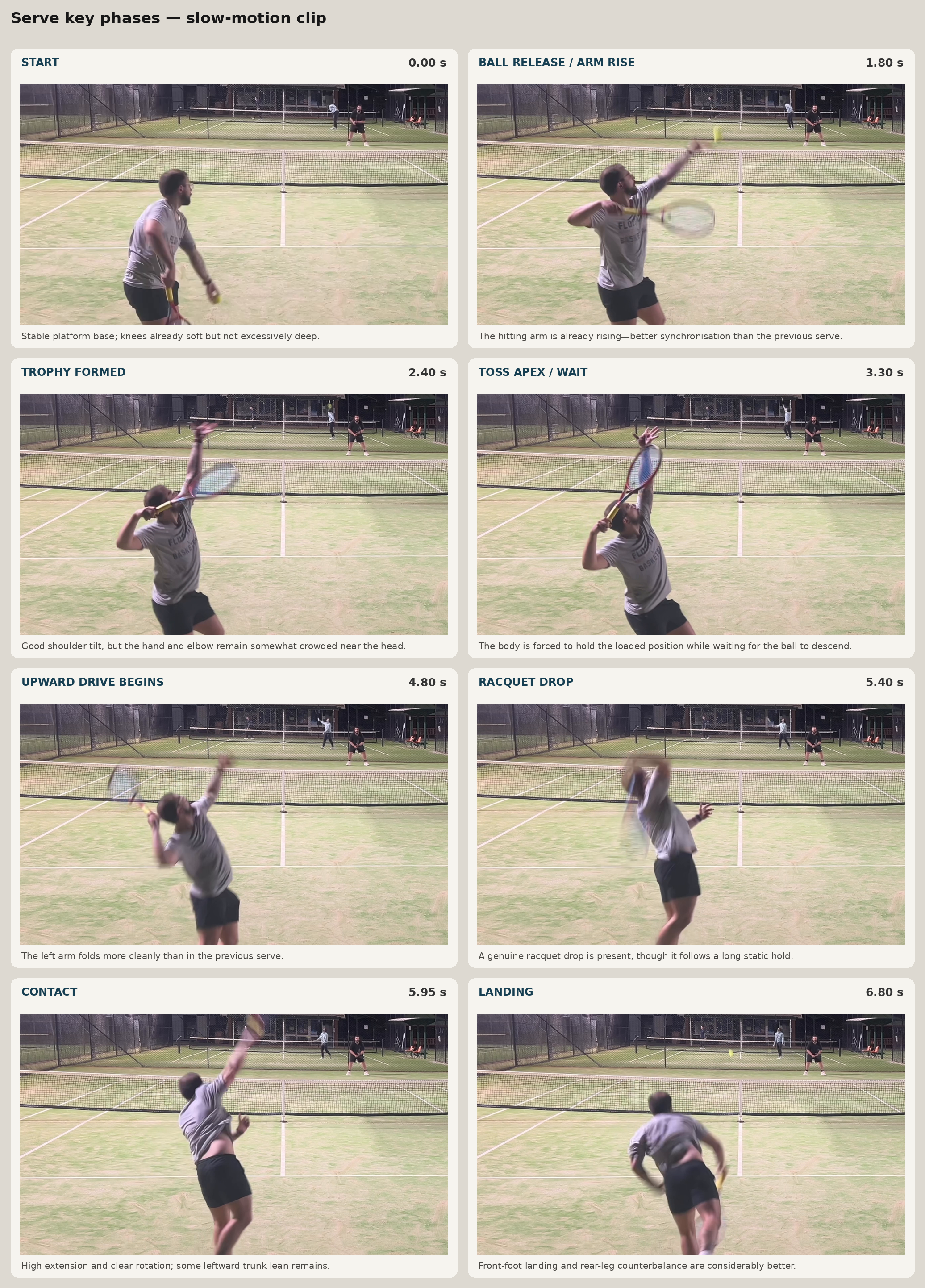
Lower the toss enough
The goal is to remove the trophy pause, not just make the toss numerically lower. The preparation is generally organised, but the ball stays in the air long enough that Matt holds the loaded position and restarts.
Keep load connected
Move directly from knee bend and trophy into the upward drive. Avoid settling or parking in trophy before restarting the motion.
Create hitting-arm space
Keep the racquet hand farther from the ear and separate the hitting elbow slightly more from the ribs.
Standardise the second serve
Matt already has a functional spin serve and makes around 60%. Standardise the toss, rhythm and default target while preserving confident racquet speed instead of guiding the ball.
Use one dependable pattern
Establish a large body or backhand target. Aim for 75-80% in structured practice before adding more directional variety.
Return
View return visual guide
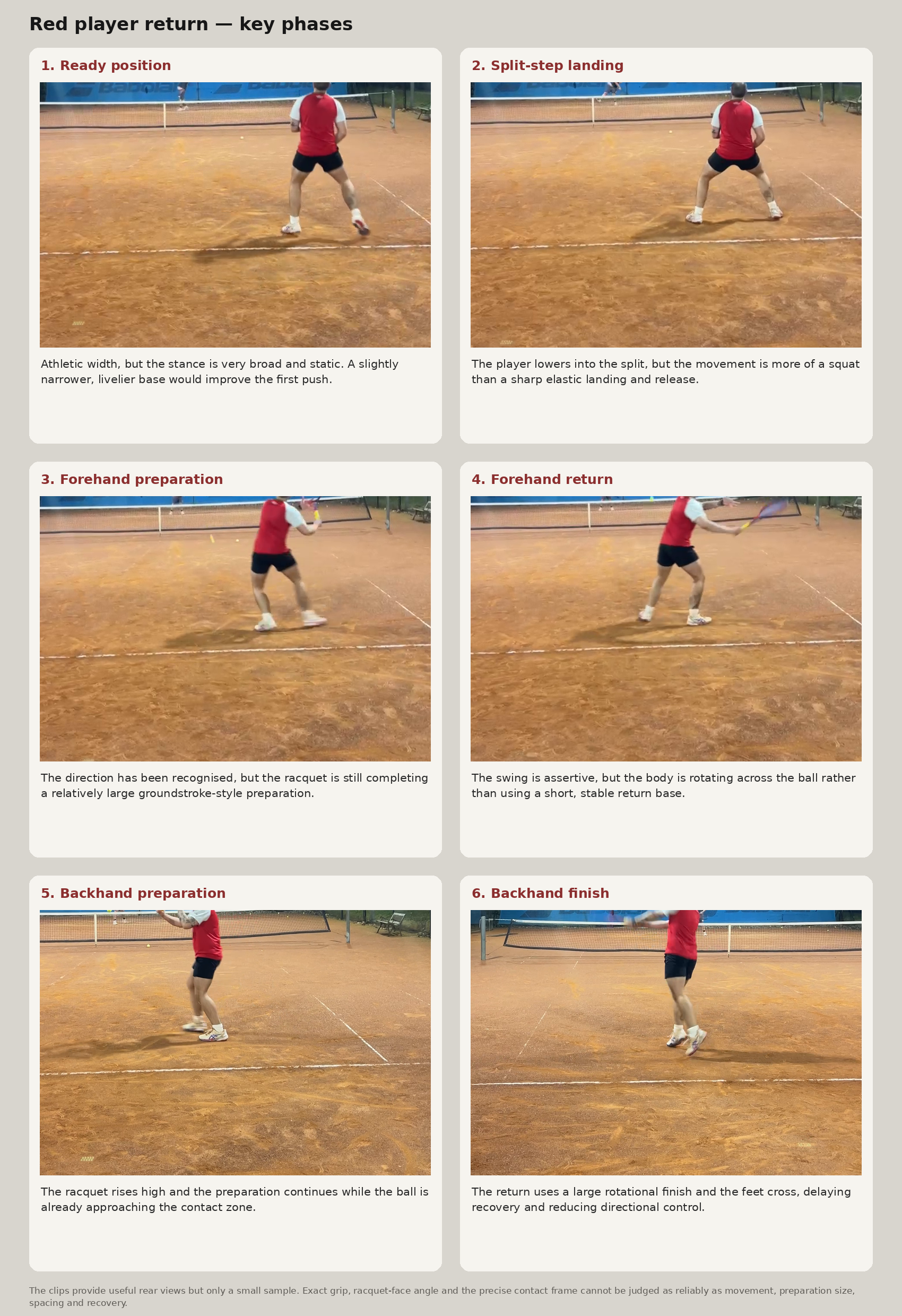
Make the split elastic
Use a slightly narrower stance and leave the ground, or at least unweight, at server contact.
Turn earlier
Complete the unit turn with the first directional movement and prepare before the bounce.
Shorten both take-backs
Keep both return swings compact, especially on the two-handed backhand.
Improve contact spacing
Move the body to the ball and contact farther in front rather than relying on late rotation.
Recover sooner
Reduce rotational excess, finish under control, and treat the return as the first shot of a two-shot sequence.
03Training Blocks
Serve
Serve rhythm: lower toss, no pause
Use this as Matthew's next serve progression. The aim is to turn preparation, load and swing into one continuous motion before adding full leg drive back in.
First Serve
Toss, move, catch
Complete three sets of 10. Use the normal serve preparation, toss the ball, keep moving into trophy, and catch the ball with the tossing hand at or just above the ideal contact height.
The toss should not hang so high that there is time to settle and wait. Pass the set when at least eight of 10 tosses allow continuous motion with no visible pause.
One, two, hit
Complete three sets of eight shadow serves using a slow count: one starts the arms, two reaches trophy with the knee load, and hit means drive and swing straight away.
There should be no extra wait after trophy. Film one set from behind and check that the motion keeps flowing through the load.
Smooth contact first
Serve 12 balls at 50-60%. Use a reduced toss height, no deliberate jump, a loose 3/10 grip, and a continuous move through trophy.
If the motion freezes at trophy, catch the toss or stop the rep. The target is rhythm and smooth contact, not pace or making every ball.
Space, then throw
Complete two sets of six. Before each serve, rehearse one trophy pose with the hand away from the ear, elbow separated from the ribs, shoulder tilt held, and racquet arm relaxed.
Then serve at about 65%. The only cue is space, then throw.
Load and go
Once the lower toss is working, serve four balls at 60% with minimal leg drive, four at 70% with moderate leg drive, and four at 80% with normal leg drive.
The legs should come back without bringing the trophy pause back. Keep the cue simple: load and go.
Stick the finish
Finish with 10 serves at 70-80%. After each serve, land on the front foot inside the baseline, keep the rear leg behind, hold the landing for two seconds, then recover and split step.
Matthew's landing is already a strength, so this drill protects it while the toss and rhythm change.
Keep the mind quiet
For the next session, use only two cues while serving: lower toss and no pause. Once those improve, add hand away from the ear.
The serve is close to being a reliable first serve. The biggest gain is making preparation, load and acceleration feel like one uninterrupted action.
Two-serve ladder
Play service games where a double fault costs two points. Target 60% first serves and a second serve that lands deep through the middle third.
Second Serve
Same swing, safer shape
Use a topspin-slice second serve as the default. Keep a continental grip, toss around 12 to 12:30, swing up fast, clear the net comfortably, and aim mostly toward the receiver's backhand or body.
Safety should come from spin, height and target choice, not from slowing the racquet arm.
First toss, second toss
Place two court markers: the first-serve marker farther forward and slightly right; the second-serve marker closer to the baseline and closer to 12 o'clock.
Complete 10 first-serve tosses, 10 second-serve tosses and 10 alternating tosses without swinging. Pass when at least eight of 10 second-serve tosses peak similarly, stay in the overhead lane, and do not force a wait.
Place, load, go
Do 15 toss-trophy-go reps without hitting: toss, move into trophy, immediately begin the upward drive, then catch the ball or let it fall. There should be no parking at trophy.
Then serve 15 second serves, but swing only at tosses in the correct window. Track acceptable tosses and made serves from those tosses. Move on at 12 acceptable tosses and nine made serves.
Up, load, throw
Complete three sets of eight continuous shadow serves. Use the rhythm up, load, throw, with the throw following immediately after the load.
Add eight walking-start serves at about 60%, then six pairs alternating one walking-start serve and one normal serve. Film four normal serves and pass when at least three keep moving from knee load into upward drive.
Fast racquet, high window
Hit 12 service-line second serves at 40-50%, looking for a curved trajectory, at least one metre of net clearance, confident upward acceleration, and a ball that dips into the box.
Move to three-quarter court for three sets of six: one set for maximum clearance, one for visible spin, and one for the best mix of height, spin and depth. From the baseline, make 11 of 15 into the middle two-thirds without pushing.
Reach up, land through
Do 10 contact-axis shadows and freeze at imaginary contact. Check head up, hitting arm extended, chest lifted, no heavy left collapse, front hip controlled, and balance moving toward the landing leg.
Serve 10 balls at 60-70%, land on the front foot, keep the rear leg behind, and hold for two seconds. Catch deliberate bad tosses instead of turning toss errors into body-position errors.
Big target, committed shape
Build one trusted second serve before expanding targets. For training, use a large body or backhand target: ad court toward backhand, deuce court body or backhand-side body.
Serve 15 balls to the body third. Score two for the target third, one for in elsewhere, and zero for a fault; target 22 from 30. Then use groups of four: default, default, default, different target.
Three-ball clusters
Hit eight clusters of three second serves from the same side to the same target. Mark each cluster green for three in, yellow for two in, and red for zero or one in.
The target is at least three green clusters and no more than one red. After a miss, name one cause only: toss, deceleration, head down, opened early, overhit, or target too ambitious.
Trust the spin
Hit 12 second serves with this scoring: committed spin in earns two, committed spin long earns one, net or obvious deceleration costs one, wide is zero.
Then hit 10 pairs where the second ball is treated as the pressure serve after a miss. Track those second balls separately and target at least six of 10.
Land, split, play
Complete 12 second serves. After each, land inside the court, recover, split step, and shadow the likely first groundstroke.
With a partner, play 12 live return points using only second serves and stop after the server's first groundstroke or the returner's second ball. Success means the serve lands, the landing stays balanced, and the first groundstroke is controlled.
Measure the miss pattern
After technical work, hit 10 second serves from each side. Use six of 10 as the starting benchmark, seven as the development target, and eight as a strong practice standard.
For a fuller test, hit 30 second serves in five-serve blocks alternating courts. Track total made, net faults, long faults, wide faults, poor tosses caught, and serves made to the intended target. Aim for at least 22 of 30 in with no more than three net faults.
Return
Return split, spacing and recovery
This block tightens Matt's return shape: smaller split, earlier unit turn, shorter take-backs, cleaner contact spacing and faster recovery into the next ball.
Land light, leave fast
Place two cones shoulder-width to slightly wider than shoulder-width apart and start each foot near a cone. Complete 20 server-shadow reps: server serves, Matt unweights as the server rises, lands just after imaginary contact, hears forehand or backhand, makes the first push, then freezes.
Then do split-and-catch with no racquet: split at contact, turn toward the ball, move into position and catch with both hands in front. Complete eight forehand catches, eight backhand catches and 12 random catches.
Read, turn, then move
Use slow feeds or serves. Matt must complete the shoulder turn and say set before the ball bounces, then catch it or let it pass. Complete three sets of eight.
Add throat-hand preparation: keep the non-dominant hand on the racquet throat through the unit turn, turn both shoulders together, keep the racquet in front of the chest line, and release only as the forehand moves forward. Complete 10 forehand shadows and 10 live feeds.
Set beside, not behind
Place a cone, racquet bag or safe marker just behind the forehand preparation area. Use service-line feeds at moderate pace for three sets of eight, turning the shoulders without letting the racquet head travel behind the barrier.
Then complete 10 catch-and-hit forehand pairs: catch one ball in front of the forehand hip, then hit the next from the same spacing. Finish with 15 compact-finish returns to a deep-middle target, making 11 of 15 while balanced and recovering immediately.
Set and punch
Start preset on the backhand: shoulders turned, racquet beside the torso, hands around waist height and racquet head slightly above the hands. Use a short forward movement through contact for three sets of eight.
Then hit 15 backhand no-loop returns where the racquet cannot rise above roughly shoulder height in preparation. After every third return, freeze the intended contact window with hands in front, arms comfortably extended, head stable and weight balanced or moving slightly forward.
Stable hit, quick exit
Return medium-paced serves at 60% and hold the finish for one second before recovering. Complete 10 forehands and 10 backhands without falling sideways, crossing the feet immediately, spinning fully around or taking an emergency balance step.
For slow second serves, start on or just inside the baseline, split forward, move diagonally into the bounce, contact in front, let the rear foot follow through, and recover immediately. Complete three sets of six from each return side.
Block or drive
The server randomly hits a firmer serve or a slower second serve. Matt calls block or drive before the bounce. Block means small preparation, using incoming pace and aiming deep middle. Drive means step forward, use a slightly fuller but still compact swing, and aim to a large crosscourt or middle target.
Complete 24 serves and pass when the correct return shape is selected on at least 18 of 24.
Return plus first ball
Place a recovery cone near the expected centre position. After every return, Matt must touch or move around the cone before the server catches the returned ball. Complete 16 returns, counting only reps where the return lands in, balance holds and recovery begins immediately.
Then play 15 return-plus-first-ball points. Matt earns one point each for the return in play, balanced recovery and first rally ball in play.
Deep middle first
For initial training, aim primarily through the deep middle third. It gives margin, simplifies racquet-face control, reduces the server's angles, allows easier recovery and rewards a compact stroke.
Against a clearly weak second serve, add a large crosscourt target. Do not start by aiming down the line while changing the return mechanics.